
Research Interests
Research Overview:
My research seeks to understand how galaxies acquire, process, and ultimately lose the gas that fuels their evolution, and how these processes are shaped by both internal dynamics and the surrounding cosmic environment. I use deep radio observations of neutral hydrogen to trace the flow of gas into and out of galaxies, revealing how accretion, feedback, and environment regulate star formation over cosmic time. Using facilities such as the VLA and upcoming SKA pathfinders, I combine high-resolution studies of individual systems with statistical analyses of galaxy populations to investigate how mergers, interactions, and the cosmic web influence the baryon cycle. I am also interested in the role of large-scale magnetic fields in shaping gas accretion and star formation, which I study through measurements of Faraday rotation across diverse environments. To fully exploit the enormous datasets produced by modern radio surveys, I develop advanced data-analysis pipelines and machine-learning techniques designed to identify faint astrophysical signals with high reliability. Together, this work aims to connect the internal evolution of galaxies to the larger-scale structure of the Universe.
A Sampling of Previous Research:
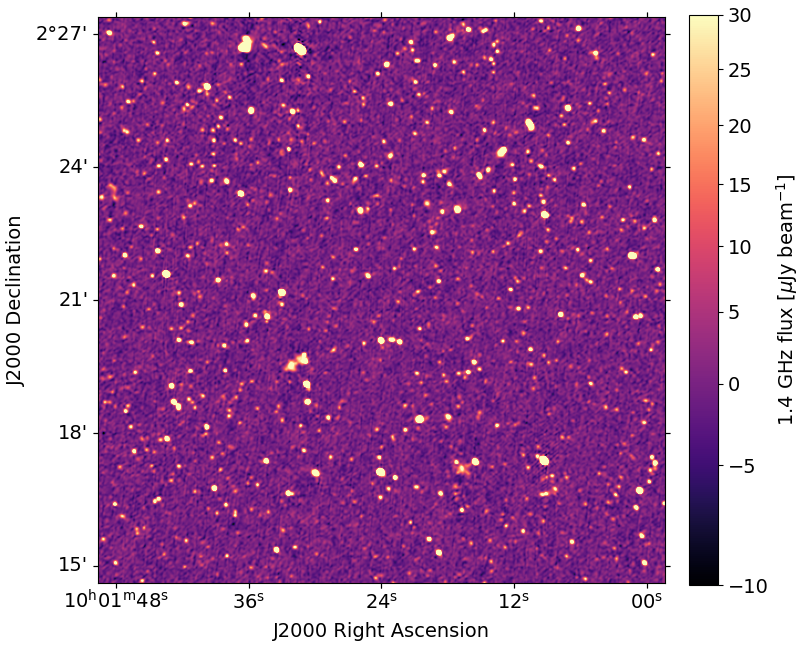 My research has focused on understanding how galaxies acquire, retain, and lose the gas that fuels star formation, and on how these processes are shaped by their environment. During my PhD at West Virginia University, I worked on the COSMOS HI Large Extragalactic Survey (CHILES), a deep Very Large Array program designed to detect neutral hydrogen out to intermediate redshifts. I developed automated calibration and imaging pipelines, created quality-assurance tools for high-performance computing environments, and implemented advanced techniques to mitigate artifacts arising from radio frequency interference and imperfect deconvolution. Building on this work, I contributed to the CHILES Continuum & Polarization Survey, which produced the deepest 1.4 GHz continuum image at sub-arcsecond resolution, and helped characterize systematic effects and refine the dataset for studies of cosmic star formation and large-scale magnetism.
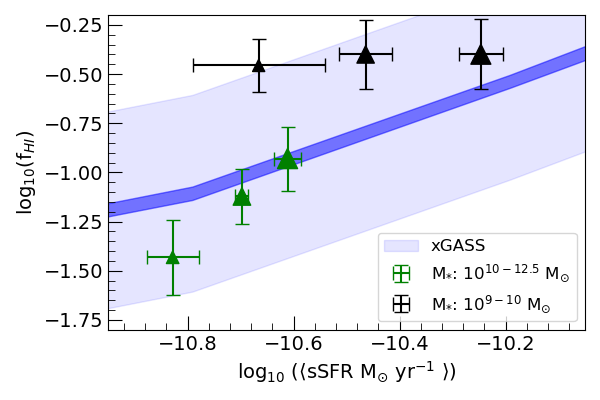 Using these rich datasets, I have applied statistical stacking methods to investigate two key questions in galaxy evolution: how the HI content of galaxies changes with mass and redshift, and how the cosmic web influences that evolution. My analysis suggests that intermediate-mass galaxies maintain relatively steady gas reservoirs across cosmic time, while more massive systems show increasing HI content at earlier epochs, pointing to differences in how galaxies acquire gas. I also explored whether the large-scale environment regulates these gas reservoirs, finding only tentative evidence for environmental effects—highlighting both the complexity of galaxy evolution and the challenges inherent in interpreting subtle trends at sensitivity limits.
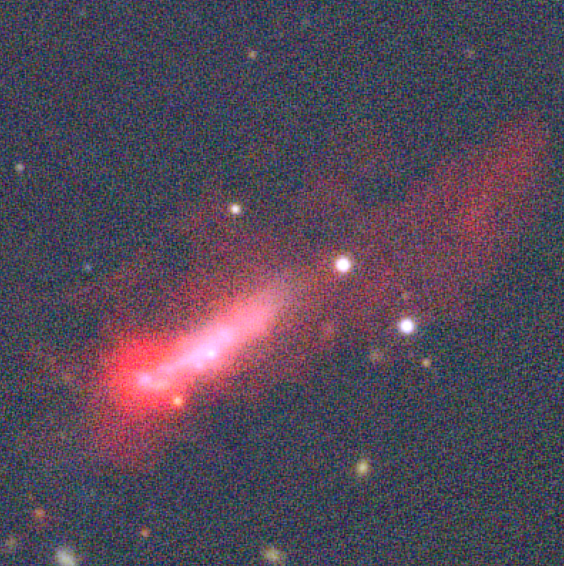 In parallel, I have examined individual galaxies in detail using high-resolution HI observations. My studies have included extreme jellyfish galaxies undergoing ram-pressure stripping, interacting dwarfs exhibiting diffuse gas bridges and extended envelopes, and most recently AGC 727130, a remarkably gas-rich dwarf galaxy with almost no star formation. Situated where multiple cosmic filaments intersect, AGC 727130 shows neutral gas extending dramatically beyond its stellar body, and my work argues that this morphology is best explained by ram-pressure from the cosmic web itself. These case studies demonstrate how environmental processes—ranging from cluster interactions to filamentary accretion—can profoundly reshape a galaxy’s gas and star-formation history.